
The Braboon Mug


The Braboon Mug
Price range: $11,99 through $13,99
One fine day, the Braboon was chilling on the side of the road near Cape Point. A removal truck, travelling from Simonstown to Hout Bay, stopped so the driver could remove some loose branches blown into the road by a vicious south easter.
Read the rest of the Braboon’s truly FAScinating story and find out more about other baboons in the description …
11oz (330ml) or 15oz (440ml) with scratch-resistant finish
All about the Braboon
One fine day, our heroine, the Braboon was chilling on the side of the road near the fabulous Cape Point Nature Reserve. A removal truck, travelling from Simonstown to Hout Bay, stopped so the driver could remove some loose branches blown into the road by a vicious south easter. Although he wasn’t out of the cab for very long, it was long enough for a couple of bags to mysteriously ‘go missing’.
A young female had wandered off from a nearby troop. Being exceptionally curious, she ripped open the bags to discover a stash of simply stunning lingerie.
Since then, the Braboon has been the envy of all the younger girls, bedecked each day in her ill-gotten finery.

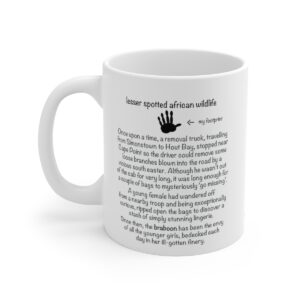
Got an expat in your life or simply yearning for the sights, sounds and wildlife of the bushveld? Our Lesser Spotted African Wildlife mugs are guaranteed to teach you lots of stuff you didn’t know about Africa and its lesser spotted and not quite as well-known, though even more fascinating inhabitants.
About our LESSER SPOTTED AFRICAN WILDLIFE Braboon latte mugs:
This is what you get when you buy mugs from Stuff by Jools, you lucky person, you!:
- ○ A unique 11oz (330ml) or 15oz (440ml) Lesser Spotted African Wildlife double-sided mug with a portrait on the front and life story on the back
- ○ Premium grade ceramics with scratch-resistant finish
- ○ Lead and BPA-free
- ○ Dishwasher- and handwash-friendly
- ○ Microwave-safe
- ○ Individually hand-made in Cape Town
- ○ The perfect gift for coffee, tea and hot chocolate lovers: friends, family members or loved ones – or for you!
- *Please don’t scrub hard with bleach and a scourer, even if you’re a die-hard germaphobe (true story) – treat your Piena mug gently and it’ll give you years of pleasure and amusement.
ALL ABOUT the BRABOON’s extended family – Baboons:
There are five baboon species in Africa. Our friend, the Braboon, is a Cape Chacma Baboon (Papio ursinus), native to Southern Africa. Her friends (many of whom are materialistic younger girls who envy her and want to be her) and family are found widely distributed throughout Southern Africa, in the Western Cape, Kruger National Park and the Drakensberg as well as in other national parks and game reserves.
KEY TRAITS:
Size and Appearance: Baboon males can weigh up to 45kg and the females 15-20kg. Their fur is dark brown to grey and rather coarse and you may notice the hardened skin pads, known as ischial callosities, on their butts. These enable them to sit comfortably on rough surfaces for quite a while (very necessary as they are often cursed by bad cases of haemorrhoids!) They have dog-like faces, with long muzzles and alarmingly scary, long canines.
Best known for: They are extremely intelligent and often raid cars, houses and rubbish bins – and will even expropriate your backpack and its contents if you’re not careful when out hiking. They can also be rather aggressive, especially if they feel they’re under threat and make a distinctive barking sound.
Lifespan: Chacma baboons can live up to 24 or 40 years in the wild.
Social Structure: They live in complex, highly organised social groups, or troops, which can be any size, usually between 15 and 200 individuals and are led by a dominant alpha male.The alpha is often challenged by young males from other roaming troops, while the females stay with their birth troop for life.
Their Diet: Omnivorous, like (most, sensible) humans, their diet is incredibly varied and includes fruit, seeds, grass, roots and even insects. They also hunt small mammals like antelope (and your kids if you don’t watch out!) and sometimes forage for shellfish and even shark eggs.
Breeding: Female baboons gestate for around 140 days (4 1/2 months) and usually give birth to one baby. They’re sexually active throughout the year and don’t have a fixed breeding period. The babies are unbelievably cute but don’t try to touch them, unless you want to experience the wrath of their parents!
Spoor Description: Their hand prints strongly resemble those of small humans. They have opposable thumbs, which enable them to perform intricate tasks, eg. peeling fruit, picking seeds and unzipping bags.

Collect the full set of 12 Lesser Spotted African Wildlife mugs and give your family and friends an inspirational topic for filling awkward silences.
| Weight | N/A |
|---|
Brand
Lesser Spotted African Wildlife

You must be logged in to post a review.


Reviews
There are no reviews yet.