
The Cheetarist Mug


The Cheetarist Mug
Price range: $11,99 through $13,99
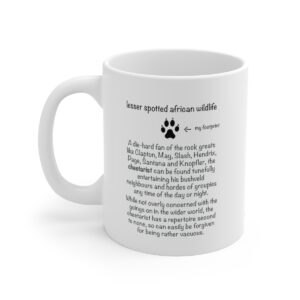
A die-hard fan of the rock greats like Clapton, May, Slash, Hendrix, Page, Santana and Knopfler, the Cheetarist entertains his bushveld neighbours and hordes of groupies any time of the day or night.
Read more about him in the description ..
11oz (330ml) or 15oz (440ml) with scratch-resistant finish
The Cheetarist is a die-hard fan of the rock greats like Clapton, May, Slash, Hendrix, Page, Santana and Knopfler. You can find him tunefully entertaining his bushveld neighbours and hordes of groupies any time of the day or night.
While he isn’t overly concerned with the goings on in the wider world, the Cheetarist has a repertoire second to none, so we can easily forgive him for being rather vacuous.

Got an expat in your life or simply yearning for the sights, sounds and wildlife of the bushveld? Our Lesser Spotted African Wildlife mugs are guaranteed to teach you lots of stuff you didn’t know about Africa and its lesser spotted and not quite as well-known, though even more fascinating inhabitants.
About our LESSER SPOTTED AFRICAN WILDLIFE cheetarist latte mugs:
This is what you get when you buy mugs from Stuff by Jools, you lucky person, you!:
- ○ 11oz (330ml) or 15oz (440ml) Lesser Spotted African Wildlife mug
- ○ Premium grade ceramics with scratch-resistant finish
- ○ Lead and BPA-free
- ○ Dishwasher- and handwash-friendly
- ○ Microwave-safe
- ○ Individually hand-made in Cape Town
- ○ The perfect gift for coffee, tea and hot chocolate lovers: friends, family members or loved ones – or for you!
*Please don’t scrub hard with bleach and a scourer, even if you’re a die-hard germaphobe (true story) – treat your Heliphant mug gently and it’ll give you years of pleasure and amusement.
ALL ABOUT CHEETAHS:
The Southeast African/Namibian cheetah (Acinonyx jubatus), like our friend, the Cheetarist, prefers to live in open plains and grasslands that allow them to reach top speeds. They also adapt to mixed savanna, woodland and thick bush where they can use termite mounds and rocky outcrops as vantage points.
The Kruger National Park and Kgalagadi Transfrontier Park have tons of them and, if you want to get up close and personal, take a trip to the De Wildt Centre, a captive breeding facility in the foothills of the Magaliesberg.
KEY TRAITS:
Size and appearance: These beautiful kitties are about 70 to 90cm tall. Males weigh between 40 and 65kg and females, 35 to 55kg. They use their long tails as rudders, helping them to balance and steer during mega high-speed turns. With slender bodies, long legs, distinctly rounded heads and small rounded, wide-set ears, they are about 2m long from nose to tail tip.
It has a concave back and lower hind quarters. This Cat is characterised by a strongly spotted coat and by a long tail which is half as long as the length of its head and body. The tail has a unique pattern of striped markings.
Best known for: Being the fastest land animal on earth. They accelerate from 0 to 100kmph in just three seconds, but can only maintain this speed for about 20–30 seconds.
Lifespan: Cheetahs typically live for 10 to 12 years in the wild but males often have shorter lives (±8 years) because of territorial conflicts. In captivity, they can live for 15 to 20 years as they’re not exposed to predators and receive quality veterinary care.
Social Structure: Females are solitary and only interact with the males to mate, even raising their cubs alone for up to two years. Males form lifelong groups of two or three related brothers to defend territories and hunt successfully.
They communicate through bird-like chirps, purrs, hisses and growls.
Their Diet: They hunt diurnally, mostly at sunrise and sunset, and are carnivorous, feeding on medium-sized antelope: impala, springbok, steenbok and duiker – occasionally even baboons, some birds, bustards, hares and porcupines. Male groups sometimes hunt larger prey like Wildebeest.
Breeding: They breed throughout the year and gestate for around three months. Litters usually produce two cubs but sometimes three to six, who are born with a smokey grey mantle on their backs for camouflage. These little babies are extremely vulnerable and often don’t live to adulthood as they are preyed upon by lions, leopards, hyenas, foxes and eagles.
Spoor Description: Their tracks are unique as their claws are non-retractable and blunt.

Collect the full set of 12 Lesser Spotted African Wildlife mugs and give your family and friends an inspirational topic for filling awkward silences.
| Weight | N/A |
|---|
Brand
Lesser Spotted African Wildlife

You must be logged in to post a review.


Reviews
There are no reviews yet.