
The Heliphant Mug


The Heliphant Mug
Price range: $11,99 through $13,99
Lesser Spotted African Wildlife heliphant mug.
A daredevil African ellie with a head for heights, the Heliphant is a self-taught aeronautical engineer. She successfully fashioned a magnificent chopper out of scrap metal and old tricycle and shopping trolley wheels she inexplicably found lying around under a baobab.
Read more about her exploits in the description…
11oz (330ml) or 15oz (440ml)
A daredevil with a head for heights, the Heliphant is also a self-taught aeronautical engineer. She successfully fashioned a magnificent chopper out of scrap metal and old tricycle and shopping trolley wheels she inexplicably found lying around under an enormous baobab.
She spends her days soaring above the plains! The Heliphant is a formidable one woman anti-poaching unit. She’s also an early warning system for impalas, zebras and buffalos who are about to become lion lunch.

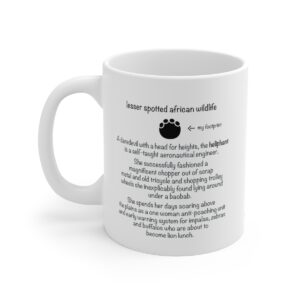
Got an expat in your life or simply yearning for the sights, sounds and wildlife of the bushveld? Our Lesser Spotted African Wildlife mugs are guaranteed to teach you lots of stuff you didn’t know about Africa and its lesser spotted and not quite as well-known, though even more fascinating inhabitants.
About our LESSER SPOTTED AFRICAN WILDLIFE HELIPHANT latte mugs:
This is what you get when you buy mugs from Stuff by Jools, you lucky person, you!:
- ○ 11oz (330ml) or 15oz (440ml) Lesser Spotted African Wildlife mug
- ○ Premium grade ceramics with scratch-resistant finish
- ○ Lead and BPA-free
- ○ Dishwasher- and handwash-friendly
- ○ Microwave-safe
- ○ Individually hand-made in Cape Town
- ○ The perfect gift for coffee, tea and hot chocolate lovers: friends, family members or loved ones – or for you!
- *Please don’t scrub hard with bleach and a scourer, even if you’re a die-hard germaphobe (true story) – treat your Heliphant mug gently and it’ll give you years of pleasure and amusement.
ALL ABOUT African elephants:
African elephants (Loxodonta africana), like the Heliphant, are found in a variety of South African ecosystems, from open savannas to dense thickets and even forests (like the famous Knysna ones). As they need a lot of food and water to sustain their enormous bodies, they need to live in areas with easy access to water and suitable vegetation.
They’re remarkably social and live in herds of varying sizes, mostly in Southern Africa (and sometimes on my roof.. although, come to think of it, the noise might just be neighbourhood cats or hadedas and my roof is in Southern Africa so that’s moot).
The Kruger National Park and Addo Elephant Park have tons of them (no pun intended).
KEY TRAITS:
Size: These magnificent creatures (the bulls) can be as tall as 4m and weigh a whopping five to seven tons. The cows are smaller and ‘only’ 2.5 to 3m tall, weighing 2.7 to 4 tons. Despite this, they’re still cute and cuddly – though I wouldn’t recommend trying to cuddle one as you may get tossed or squished.
Best known for: Being the largest land mammals, their intelligence and their wonderful tusks and huge floppy ears. PS. If their ears start flapping, run, hide or pray, otherwise you’re toast. And, of course, they’re one of the famous Big Five.
Lifespan: They typically reach 60 to 70 years old in the wild, providing they still have functioning molars and poachers aren’t active. In captivity, they only live 17 to 40 years, because of increased stress, obesity and lack of socialising. Poor, poor ellies :(
Social Structure: Ellies live in matriarchal herds and are led by the matriarch (oldest female). Mature bulls are expelled from the herds when they get to 12 to 15 years old. During musth (one of those completely unpronounceable words), adult bulls enter a state of heightened testosterone and aggression and search for receptive females to mate with.
Their Diet: They spend up to 18 hours feeding, every single day! and consume 150 to 270kg of vegetation (grass, leaves, bark, fruit and roots) and can drink up to 200 litres of water in one go.
Breeding: They don’t have a specific breeding season, though births often peak just before the rains come, after about 22 months of gestation (the longest of any mammal). One single calf, weighing about 100kg, is born at a time and cows typically have one calf every three to four years.
Spoor Description: Elephants leave large, oval-shaped tracks, with the front feet being more circular and the back ones being more oval. If the ground is soft, the ridges on the bottom of their feet create a cracked, leathery pattern. They also drop more than 150kg of large, fibrous dung ‘boluses’ every day – extremely easy to spot.

Collect the full set of 12 Lesser Spotted African Wildlife mugs and give your family and friends an inspirational topic for filling awkward silences.
| Weight | N/A |
|---|
Brand
Lesser Spotted African Wildlife

You must be logged in to post a review.


Reviews
There are no reviews yet.